• About
  • Archive
  • Contact
The Greening of Gavin
  • Home
  • Our Green Shop
    • Little Green Workshops
  • Green Workshops
    • Cheese Making
    • Soap Making
    • Soy Candle Making
  • eBooks
    • Clay Oven eBook
    • Keep Calm and Make Cheese eBook
  • Podcast
    • TGOG Podcast
    • TGoG Podcast Archive
    • Little Green Cheese
  • Vlog
  • Cheese
  • Green Living
    • Chickens
    • Gardening
    • Soap Making
    • Recipes
    • Climate Change
    • Peak Oil
    • Solar Power
  • Resources

TGoG 103 – Preparing for Winter Planting

March 5, 2015 @ 22:46 By Gavin Webber 2 Comments

[spp-player optin=”off”]

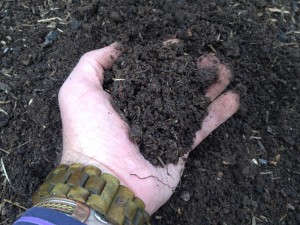
Well composted soilIt is autumn here in South Eastern Australia and time to start preparing for your winter planting. I talk about all the beds I have to prepare, what I am going to plant, basic crop rotation, and some tips about composting and worm castings and how to keep snails/slugs and earwigs off your newly planted seedlings.  Who am I kidding, the show is full of organic gardening tips!

Join me in a chat about preparing for winter planting.

Don’t forget that you can become a patron of the show and support it moving forward by visiting http://www.patreon.com/greeningofgavin

Become my patreon!


Will this article help someone you know? If so help them out by sharing now!

  • Click to share on Facebook (Opens in new window) Facebook
  • Click to share on X (Opens in new window) X
  • Click to share on LinkedIn (Opens in new window) LinkedIn
  • Click to share on Reddit (Opens in new window) Reddit
  • Click to share on Pinterest (Opens in new window) Pinterest
  • Click to share on Tumblr (Opens in new window) Tumblr
  • Click to print (Opens in new window) Print
  • Click to email a link to a friend (Opens in new window) Email
  • More
  • Click to share on Pocket (Opens in new window) Pocket

Filed Under: compost, food, Gardening, Irrigation, Organic, Podcast, Sustainable Living, TGOG Podcast, vegetables, worms

Low Pressure Drip Irrigation Part 3

November 29, 2009 @ 23:42 By Gavin Webber 6 Comments

This is the final in the series, as I have finished my drip irrigation project this afternoon. It took me another 4 hours of constant work to finish it off, but well worth the effort.  For those who haven’t read the other two parts, here are the links to Part One, and Part Two.  Best to catch up so you can understand what I am talking about in this post.

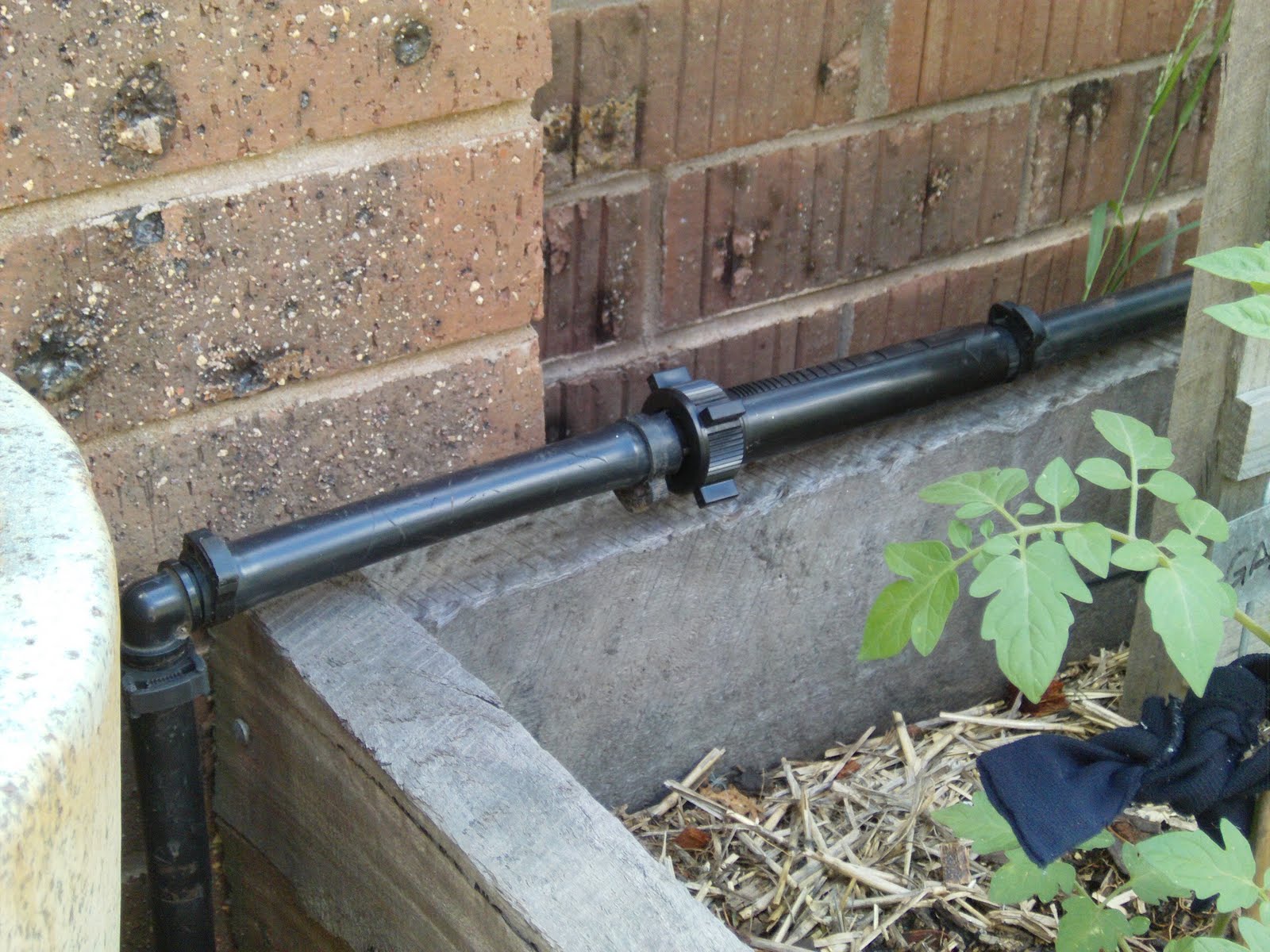
As mentioned in part 2, I laid the main 19mm line all along the back of the veggie patch beds, and inserted a 19mm to 13mm T piece so that I rig up the piping for each bed.  This is what it looked like before I started work today.  When using harvested rainwater, make sure you put in an in-line filter to stop your drippers from getting blocked.  Some silt may get into your tank so this is a simple precaution to avoid having to purge your system everytime you inadvertently put dirty water into the pipes.  Here is the filter setup;

Here is the mainline with the T pieces inserted;

So, today I began by making a set of isolating taps for each bed which were all 13mm fittings.  It was a little bit fiddly, but once I made one, I managed to bang out the other 4 very quickly.  This is the mainline isolation tap and the secondary tap assembly for one of the beds;

Then I put in a secondary line of 13mm pipe, down at the level of the soil, and then ran a few tertiary 13mm line down the length of each bed and used Moss Inline 13mm drippers where there was a plant.  This is quite easy to do, but much simpler if you lay the pipe and drips before planting.  You can get to all the bits without damaging existing plants.  This is the first garden bed completed (tomatoes, leeks, and red onions);

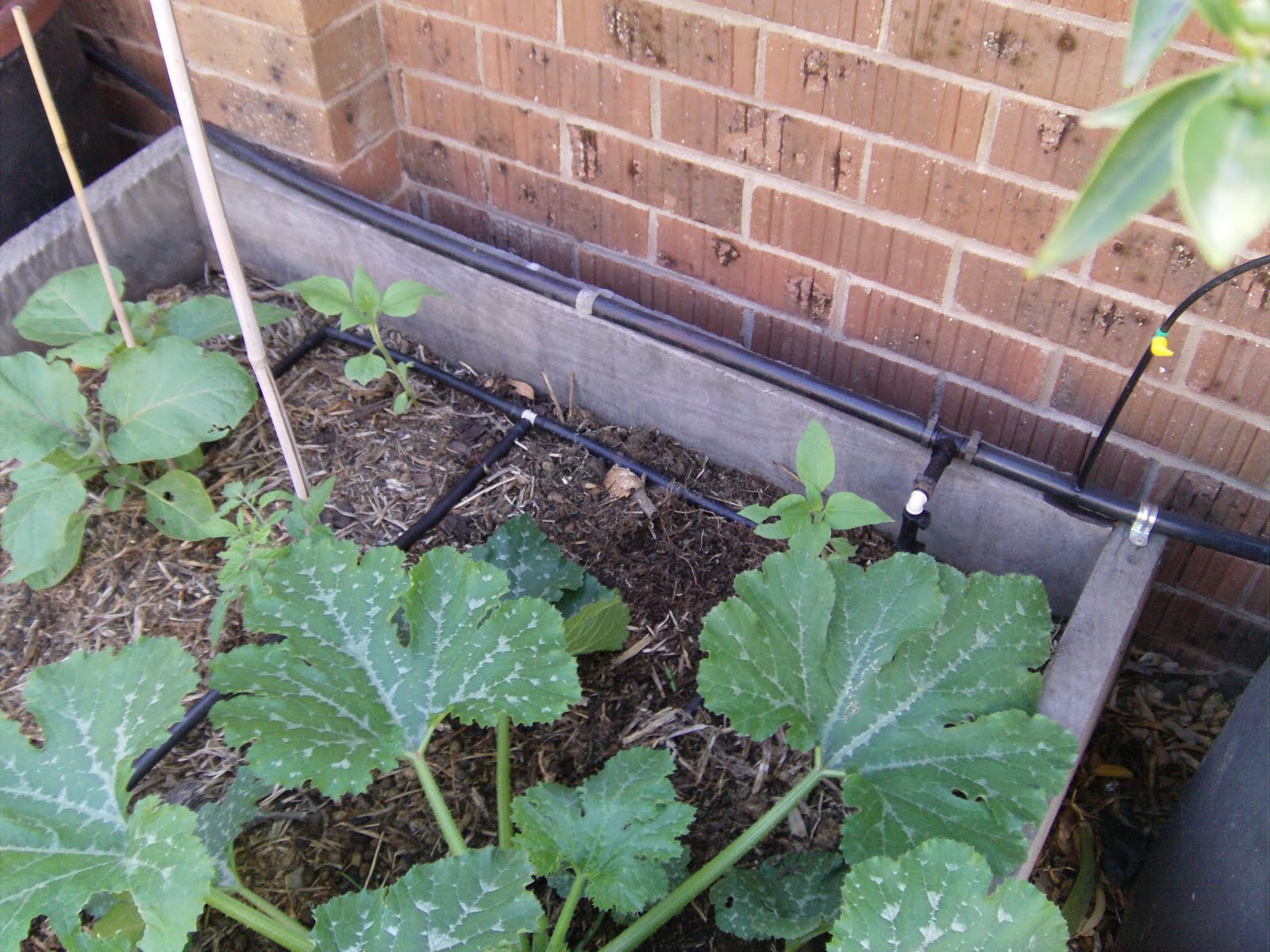
 The second bed with three tertiary lines (zucchini, cucumber, and eggplants);

The third where I used 4mm Drip Eze by Pope irrigation systems (click the link for an installation video).  20metres cost me about $25 and I still have about half of it left over.  Each drip point in the hose releases 2 litres per hour (click photo to enlarge);

The fourth bed (tomatoes) where I used the inline 13mm drips;

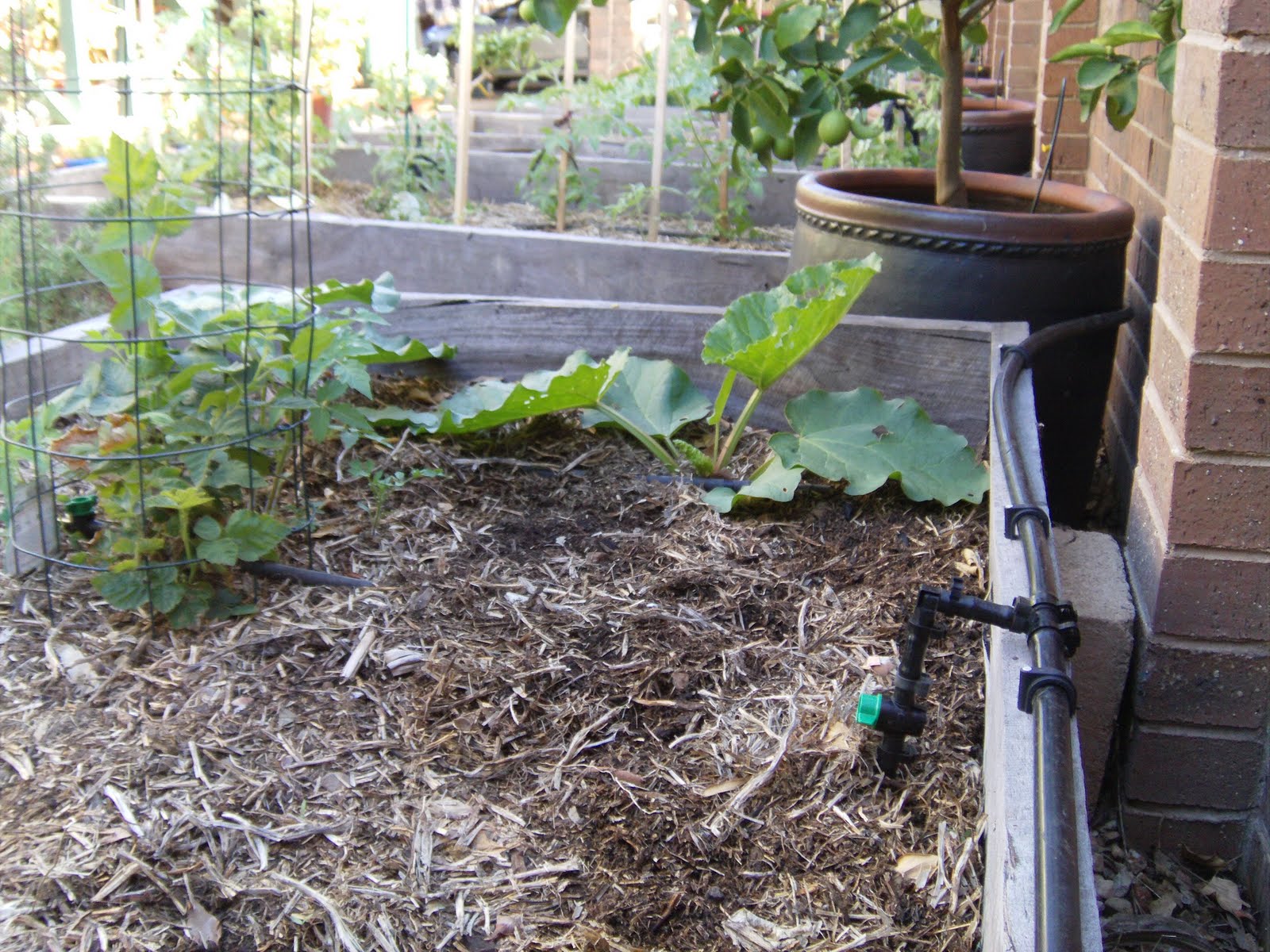
And finally the fifth perennial bed;

After all the beds were completed, I got stuck into putting in 4mm lines with little taps for each of the fruit trees in pots.  I used the lasso method, where you use Drip Eze to make a circle around the tree all joined by a 4mm T.  This method give you about 4 drips per plant and cover the entire root zone.  This will make it easier to water the potted trees and I will still be able to isolate them if the need arises;

I gave Kim the grand tour, and tested each bed to make sure everything worked without any issues.  As I had reused old 13mm poly pipe that I had kept from old installations, I had missed one hole that I missed during installation, but quickly fixed it up with a bit of black silicone and a goof plug.  All sorted and each bed worked fine.  Then I turned it all off, because the beds were already damp from all the rain we have had recently.

With all that finished, Ben helped me to planted up the empty bed with some mixed lettuce, spring onions, and celery seedlings which should all grow like crazy, now that I can irrigate straight to the root zone.  I then showed Ben how it all worked by turning on one of the 100L water butts and turning off all beds except for the newly planted one.  He was absolutely fascinated and wanted me to check every single dripper to make sure that our plants were getting watered.  It was all working as designed, with both of us being quite thrilled to see it all working.  I then poured about 2 litres of worm wee into the water butt we were using so that the plants would not suffer from transplant shock.  The beauty of using these small water butts is that you can add organic liquid fertiliser or soil conditioner and you will not contaminate all of the other water tanks/butts.  Also, by using the 100L water butt, you can water 2 beds at once and just let it all drain overnight until empty.  That way, you will not forget to turn off the tap if using your main tank. 

Over the course of an hour and a half, the Drip Eze bed only used 50L, which I thought was good, as each of the seedlings were well watered in.  I then turned that bed off, and let the remaining 50L water all the fruit trees and the rhubarb and loganberry bush.  In the morning as I leave for work, I will turn off all the taps and re-fill the empty butt from the main tank in case it rains during the day.  I don’t want any water going down the storm water drain now that I have created this marvellous drip irrigation system.

I have quite a few bits left over, and once the red onions have been pulled, I will run two more tertiary lines down bed one, and plant some more tomatoes.  That should be just before Christmas, so I better keep the seedlings I have growing well cared for until then.  Also, once the rainbow chard sets seed, I will be pulling them and planting some more types of berries, and have designed the irrigation system in bed 5 to cater for this. 

All in all, the entire system of Drip Eze line, Moss Inline drips, T’s, elbows, ratchet clamps, taps, filter and end stops cost me about $160 in parts (I still have about $40 worth of bits that I didn’t use), the 2 x 100L water butts were $59 each, with the 200L water butt and stand costing $110.  All 19mm and 13mm pipe was free because as I mentioned before, I used poly pipe from an old system.  I still have about 5 metres spare just in case I need to connect up the new tank that we are saving up for.  It was great fun, and I have an overwhelming sense of accomplishment by doing it all myself.  Once I put my mind to it, there is nothing I can’t achieve!

Next weekends project is to fence off some of the chicken run so that we can use the path again without having to sweep it every day, and to be able to use the garden bed in that area with out the chooks eating everything in sight.  I am going to put drip irrigation in that bed is well by extending the line on that side of the house!

Will this article help someone you know? If so help them out by sharing now!

  • Click to share on Facebook (Opens in new window) Facebook
  • Click to share on X (Opens in new window) X
  • Click to share on LinkedIn (Opens in new window) LinkedIn
  • Click to share on Reddit (Opens in new window) Reddit
  • Click to share on Pinterest (Opens in new window) Pinterest
  • Click to share on Tumblr (Opens in new window) Tumblr
  • Click to print (Opens in new window) Print
  • Click to email a link to a friend (Opens in new window) Email
  • More
  • Click to share on Pocket (Opens in new window) Pocket

Filed Under: Irrigation, reuse, Water harvesting

Low Pressure Drip Irrigation Part 2

November 23, 2009 @ 22:12 By Gavin Webber 2 Comments

When I got home tonight, I went and inspected the work I completed yesterday, only to find a small puddle at the bottom of the 100L water butt that I had sat on the ground.  In my haste yesterday, I had bent the tap and the rubber grommet was not forming a seal.  I lost about 25L during the day.

I decided to fix it up straight away, but as I was unable to lift the 100kg of water, I had to drain ¾ of the butt into the veggie patch before I could disconnect it.  I found a very large terracotta pot with a crack in it, so I turned it upside down and used it as the base for the water butt which gave me a little more pressure from this butt and it is now above the level of the garden beds.  I fixed up the tap, stopped the leak, and made sure that everything still worked.  All good for now, and no more leaks.

I then tested the solenoid.  I removed the 19mm plug that I had put in the end of the main line and started to manually start each of the stations on the automatic control panel.  It took a while, but I figured that it is station #2 and the solenoid works fine.  So far so good.

I then cut the main line level with the top of the garden bed, put in a 19mm elbow joint, and then inserted a 19mm in-line filter to ensure that no dirt from the rainwater tanks would block the drippers when I start the system.  I then put a 19mm in-line tap so that I can fill each butt from the main rainwater tank, and so I can isolate all the garden beds with just one tap.  It was just on sunset, and by this time I had an audience with Kim and Amy watching me lay more 19mm pipe across the back of each bed.  Amy decided to help me out, so she became my girl friday and handed me clips and nails to hold the pipe in place so that I could fasten the pipe to the wooden garden beds.  At the end of each bed I put a 19mm to 13mm T piece so that I can start the next stage on Wednesday night.  I finished the main line for four of the five beds before I ran out of 19mm hose clamps so I stopped for the evening.  I will have to pick some up tomorrow.

Sorry that there are no photos today, but by the time I finished, it was very dark.  I will take pictures of the handy work tomorrow, I promise.

Will this article help someone you know? If so help them out by sharing now!

  • Click to share on Facebook (Opens in new window) Facebook
  • Click to share on X (Opens in new window) X
  • Click to share on LinkedIn (Opens in new window) LinkedIn
  • Click to share on Reddit (Opens in new window) Reddit
  • Click to share on Pinterest (Opens in new window) Pinterest
  • Click to share on Tumblr (Opens in new window) Tumblr
  • Click to print (Opens in new window) Print
  • Click to email a link to a friend (Opens in new window) Email
  • More
  • Click to share on Pocket (Opens in new window) Pocket

Filed Under: Gardening, Irrigation, water, Water harvesting

Next Page »

Search This Blog

Follow my work

About Gavin Webber

About Gavin Webber

An Ordinary Australian Man Who Has A Green Epiphany Whilst Watching A Documentary, Gets a Hybrid Car, Plants A Large Organic Vegetable Garden, Goes Totally Solar, Lowers Consumption, Feeds Composts Bins and Worms, Harvests Rainwater, Raises Chickens, Makes Cheese and Soap, and Eats Locally. All In The Effort To Reduce Our Family's Carbon Footprint So We Can Start Making A Difference For Our Children & Future Generations To Come.

Delve Into the Archives

Visit Our Online Simple Living Shop

Little Green Workshops

Top Posts & Pages

Hot Chilli Chutney
Free Loganberry Plants
Strawbridge Family Inspiration
Low Pressure Drip Irrigation Part 1
How To Regrow Spring Onions
Home Made Camembert
Wensleydale Cheese Recipe and Method
It's Not Easy Being Green TV series
How To Remove Scaly Leg Mites
Our Soap Recipe

Recent Awards

Recent Awards

Local Green Hero

Categories

Favourite Daily Reads

Debt Free, Cashed Up, and Laughing

The Off-Grid Solar House

Greener Me

The Rogue Ginger

Little Eco Footprints

Down To Earth

Surviving the Suburbs

Little Green Cheese

Eight Acres

The Witches Kitchen

TGOG Readers On-line

Carbon Offset website

Copyright - Gavin Webber © 2026