
Today I made Parmesan for the third time, even though I felt washed out, and went to check my blog for the recipe and noticed that it wasn’t posted. Parmesan is really called Parmigiano Reggiano, named after the two regions in Italy where it is made. It is one of the worlds most famous grating cheeses. Normal sized wheels of Parmigiano Reggiano weigh about 46 kg each, but this recipe is modified to make 1 kg of this delicious cheese. It certainly beats the crappy, smelly, powered cheese you can buy in those green containers! Everyone in my family gives it a massive two thumbs up, and we eat it shaved or grated on many types of pasta dishes.
So, in an attempt to aleviate that omission, here is how I made it.
Ingredients:
Brine solution (1 litre water plus 2 tablespoons non-ionised salt, boiled for 5 minutes)
4 litres full cream milk, at least 3.4% fat
4 litres lite or semi skimmed milk, no more than 1.4% fat.
1 quarter teaspoon direct set Thermophilic starter culture
1 quarter teaspoon Lipase powder, mixed with 20ml of unclorinated water
2.5 ml rennet mixed with 60 ml unclorinated water
2.5 ml Calcium Chloride mixed with 60 ml unclorinated water
As usual I set up all the utensils and ingredients before I begin, then I sterilise everything in water in the 8 litre pot for 15 minutes. People are often surprised to discover that it is made with low fat milk (no more than 2.5% fat), because it has such an intense flavour.

Once sterilised, I put the big pot on a small saucepan of water to act as a double boiler.

Add the milk and alternate a litre of each type to so that it mixes well, and then bring the temperature up to 35C. Once at temperature, add the Thermophilic culture and mix well. Cover and allow to sit for 15 minutes.

Add the Calcium Chloride and mix well. Then add the Lipase mixture and stir for a minute. Keeping the mixture at 35C, add the Rennet mix and stir for at least 1 minute. Remove from heat. Cover and allow to set for 45 minutes.
When you get a clean break, cut the curd by using a balloon whisk. Push the whisk all the way to the bottom of the pot and lift back out. Do this all the way around all over the surface for 3 times. This will ensure that you have cut the majority of the curd to about 4mm. Let stand for 5 minutes, then stir at 35C for 10 minutes

Increase the temperature to 42C over half an hour and hold this temperature for 15 minutes continuously stirring with the whisk to prevent matting. You will notice that the curd will start to shrink into smaller grain sized pieces.
Increase the temperature to 52C over half an hour stirring regularly. When the temperature has been reached you should notice that the curd will have a very small grain size and that it will be dry to touch and squeeky when you chew them to test for doneness. Let the curds rest for 5 minutes off the heat
Drain the curds and whey into a cheese cloth lined colander. Be careful as the whey is quite hot. Gather up the cheese cloth and form a ball of curd big enough to fit into your 900gm mold. Cover one of the corners of the curd with the cheese cloth and top with the follower then press at 2.5kg for 15 minutes.
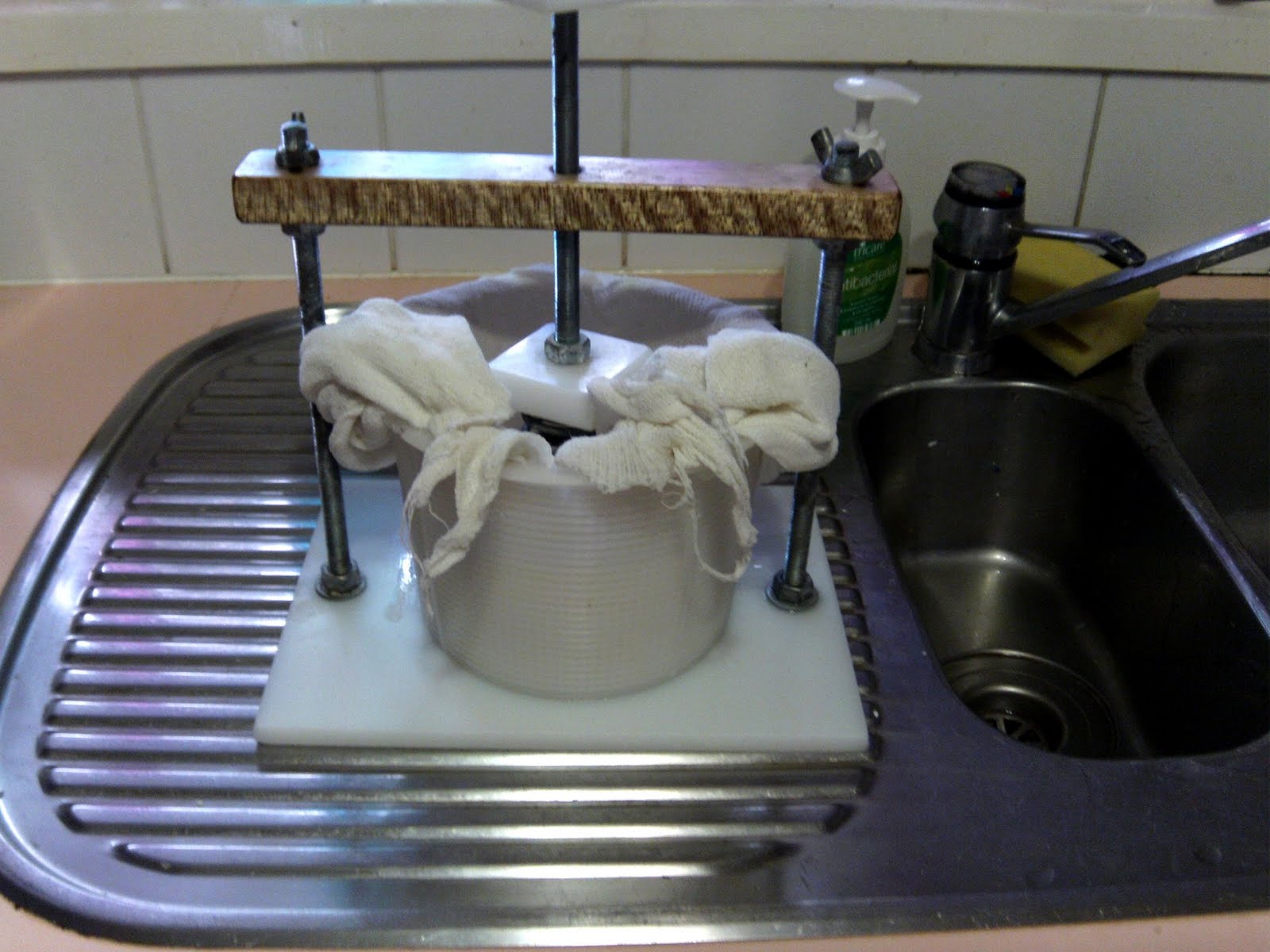
Remove the cheese from the press, and slowly unwrap the cloth. Turn the cheese over, rewrap it in the cloth, and press at 5kg for 30 minutes. Repeat this procedure, press at 7.5 kg for 2 hours. Repeat again, pressing at 10kg for 12 hours.

Remove the cheese from the mould and unwrap. Immerse the cheese in the brine solution. I use a 2 litre icecream container, add the cheese first then pour over the brine. The brine should be at room temperature and not hot or the cheese will begin to break up and absorb too much salt.

Leave it at room temperature (21C) for 24 hours, and flip the cheese occasionally.
Take the cheese out of the brine solution and pat it dry with paper towel. Here is your chance to smooth the cheese with your hands if there are any rough bits. Then place on a sushi mat and put it into the cheese cave at 13C/80% humidity for 10 months. Turn the cheese daily for the first week, then weekly after that. Remove any mould that forms on the exterior with some left over brine and a bit of cheese cloth. This also helps to harden the cheese as it ages.
I usually wax this cheese at about the three month mark, because otherwise, even if rubbed with olive oil the wheel is just too small to hold the required amount of moisture and it will dry out. The first wheel of Parmesan made in May last year turned out very well and has that sharp flavour that Grana cheeses are well known for. Here is some I grated with a fine grater and keep stored in the freezer. We use a teaspoon per serve of pasta, as it is so flavoursome.

I am leaving the second wheel for a full year, due to be cracked open on my birthday in May. I am looking forward to a few slices of shaved Parmesan on my birthday dinner!
The trademark texture and flavour of this cheese is obtained though the lengthy maturation process which results in a cheese with a hard, gritty texture. I guarantee that this cheese is well worth the wait.

Fantastic! I am thrilled to hear you’ve already made it 3 times. I haven’t attempted it yet, but hope to do so in winter. Good to see you are still in full swing with your cheese making. 🙂
After all the time to make that cheese, and subsequent (very understandable) fatigue you still took extra time out to blog to show us how? Wow, Gavin, you’re a true bloggy greenster and cheesemaking hero. Hope Kim didn’t get all the washing up.
Sending huggles and care to you both, and to the chookies.
That really looked like so much fun. I am envious
I am looking forward to trying this! I usually lurk, but wanted to say that I am hoping that you soon feel 100%!
i’ve been looking through your cheese recipes, and they seem so intimidating! i hope i can make at least one round of camembert. have you tried mozzarella?
Hi Fraichement,
No, I am yet to give mozzarella a go. I hear that it is quite easy to make. I will have to give it a go in the spring.
Gav