
As I am beginning to run more and more appliances off of my battery bank (including my hair clippers), I have found that I needed more capacity.
Over the last month we saved up another $200 to buy a second 105Ah AGM deep cycle battery. I picked it up this morning, then popped in to visit my friendly local auto electrician to see if he could make me up some battery interconnection cables with 8mm lugs. It turned out that he could for $15 each, which was cheaper than I could find on eBay (with postage).
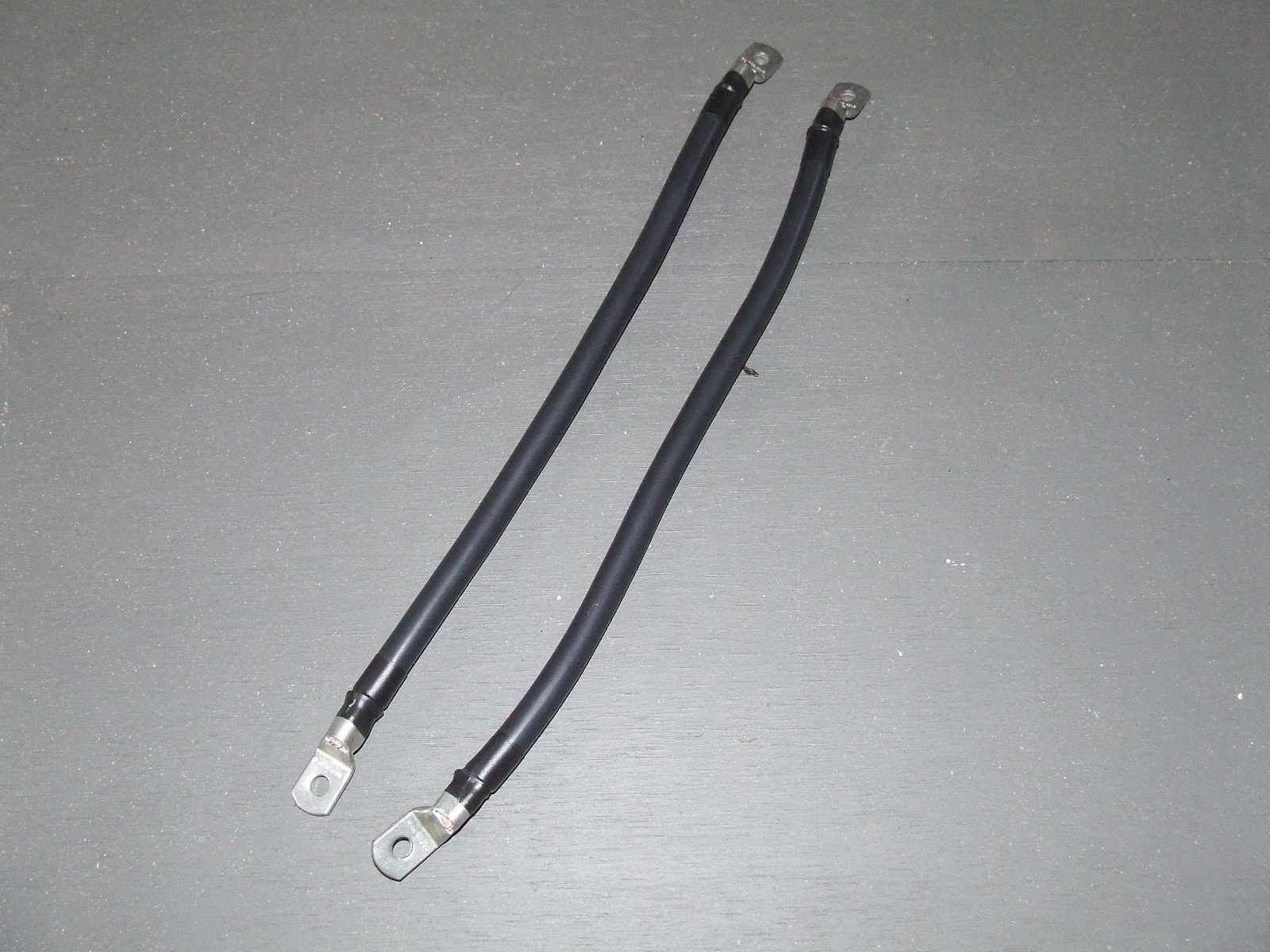
The cables are 300mm (1 foot) long, about AWG 3 (25mm sq), and are crimped with a 60kg crimper. Rated at about 400 amps, it will easily handle the 13 amp charge and 90 amp discharge across the two batteries.

I placed the new battery into the battery box, and before I hooked them up I had to figure out the best way to draw current from them. I found this site that suggested that the best method to connect 12 volt batteries in parallel was to add/draw current from the positive terminal of the first battery and the negative terminal of the second battery. This way both batteries charge/discharge fairly equally. You can read how to connect the multiple batteries here. I chose method 2 for obvious reasons if you read it.

So you can see that I have the two new cables connected positive to positive (red to red) and negative to negative to keep the voltage at 12 volts. The red inverter cable and +ve charge controller are connected to the positive on the left battery, and the negative inverter and -ve charge controller are connected to the negative terminal on the right hand battery. I then tested everything and the voltage was all at 12 volts wherever I tested. Once turned back on, the charge controller began to bulk charge the battery bank, after my haircut.
I am very pleased with it and estimate that I now have ample capacity as an emergency backup for the fridge or whatever else I want to run from it (under 1000 watts). The water pump is only drawing a small percentage of the total capacity every few days when the garden beds start drying out, and if on during the day, it runs draws current straight from the solar panels, and bypasses the batteries. Looking forward to using it more and more. I am now looking to string some permanent LED lighting up in the carport instead of the 6 very old fluoro tubes that are installed. That would give me enough light to work on projects or on my seed table at night. All for free, and without cutting into the grid at night!
Speaking of haircuts, lets see if Kim posts a comment about the funny thing that I did when I cut my hair today. I made a silly mistake but she can tell the story!

Hi Mate,
yes that is the correct way to connect the batteries.
Electrically it is essentially the same, chemically it better balances the batteries
That’s probably the best explaination I have seen for connecting multiple batteries.
Yes, it is a good way to connect the batteries. In practice, with only two batteries it is not critical (The simpler connection only puts them about 5% out of balance and they tend to balance as they discharge and also recharge) but if you can do it easily, why not!
With more than two batteries using method 2 is the usually the most practical. The way I usually do it is connect to the two middle batteries instead of the end batteries but the principle is the same and so is the end result.
Nice bit of research, most people wouldn’t have picked that up.
Cheers
MOC
Thanks Gents. Before the installation of the system, I did a lot of research. In fact probably more research time than the actual installation. I like to ensure that I have it all figured out in my head before I do anything, less chance of costly mistakes that way!
Gav
Gavin – I love this supplementary electricity system you’ve built. I’m adding it to my list of projects for the next year or two. Do you have a vision of it growing larger still? I have a garage at my place but there is no power to it so I’m thinking this sort of thing would be just perfect to be able to set up some lighting, put the cordless drill on to charge, the electric bikes, and allow me to plug in the spare fridge that sits out there doing nothing if we ever get a sustained power outage. I thought it may have been just outside of my own abilities, but you’ve made it look quite achievable providing I do some reading up beforehand. Cheers mate, you just keep on inspiring me!
Hi Michael.
It think that I may add a small vertical axis wind turbine (about 50 watts/4amps) in the future, but the battery bank will stay the same. It is indeed a great little emergency backup, and the batteries should last at least 5-7 years before they need to be replaced, maybe even longer with care.
If I can do it, you certainly can!
Gav
How big is the spare fridge? your looking at a very significant power usage difference going from a bit of lighting (low energy) and battery charging to running a fridge. Obviously it can be done but it will be significant additional expense.
(my fridge uses roughly 800w per day (less than average its a fairly small fridge), vs probably a total of 100w I use for lighting (6w LED light globes x 3 x 4-5 hours a day) and i really wouldn’t know how much to charge a battery but I cant imagine it being that much)
Thanks man, keep it up.