
• About
  • Archive
  • Contact
The Greening of Gavin
  • Home
  • Our Green Shop
    • Little Green Workshops
  • Green Workshops
    • Cheese Making
    • Soap Making
    • Soy Candle Making
  • eBooks
    • Clay Oven eBook
    • Keep Calm and Make Cheese eBook
  • Podcast
    • TGOG Podcast
    • TGoG Podcast Archive
    • Little Green Cheese
  • Vlog
  • Cheese
  • Green Living
    • Chickens
    • Gardening
    • Soap Making
    • Recipes
    • Climate Change
    • Peak Oil
    • Solar Power
  • Resources

Salami Update – Week Two

August 21, 2014 @ 22:11 By Gavin Webber 5 Comments

After two weeks of curing, the salami looks quite good.

I was told on the course that white mould was a good sign that everything was going perfectly.  I am glad that my laundry could oblige with such an abundance!
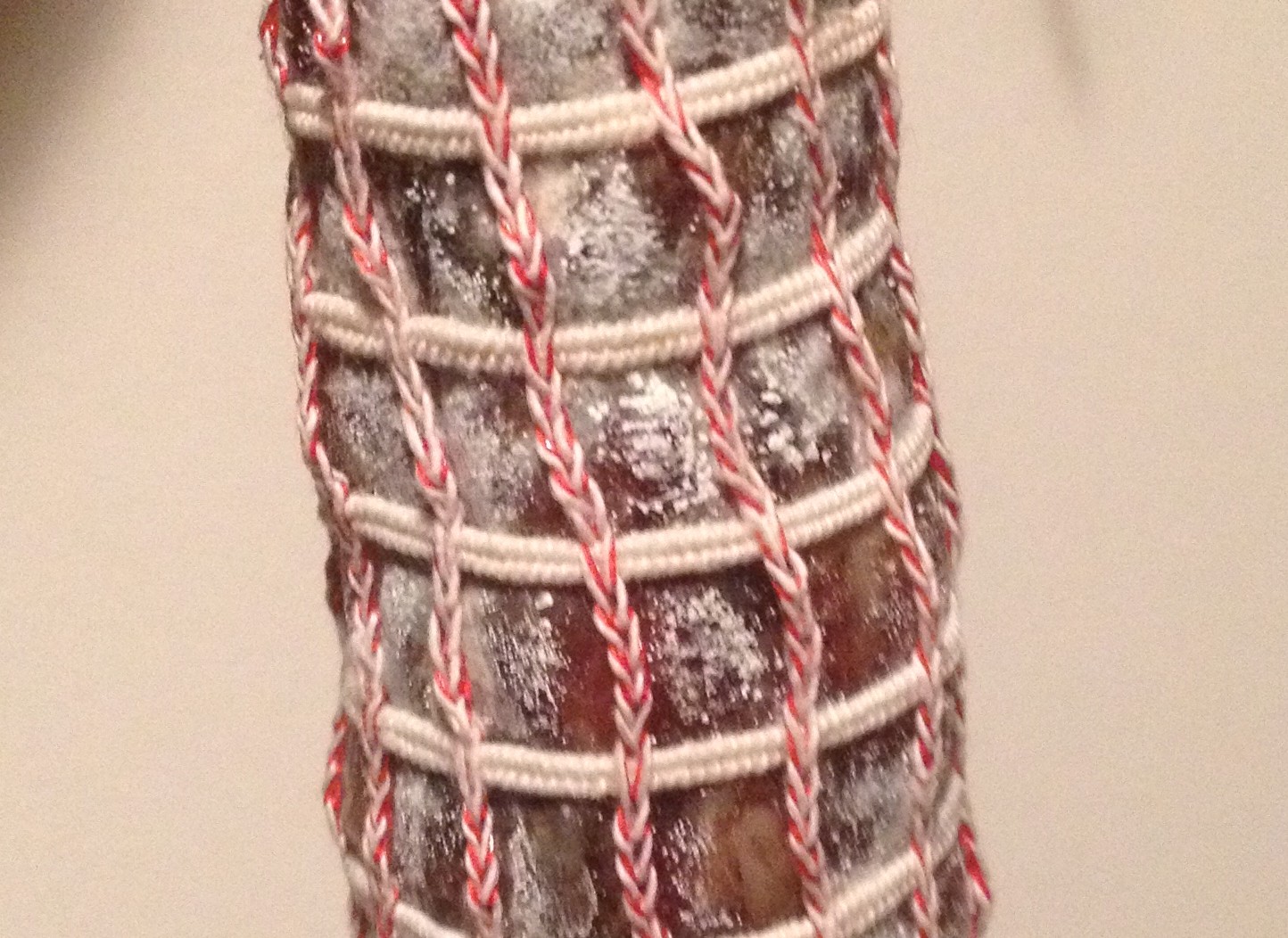
Salami after 2 weeks curing

Salami after 2 weeks curing

As you can see, it is very white in places.  It smells unlike you would expect, a little bit like old socks during the first week, but now it is more mellow like traditional salami I remember buying when visiting Rome way back in the 80’s.

At this rate the entire salami will be covered in white mould by the end of the curing period, but as it is losing moisture, it may not grow any further.  I will then wipe it off after removing the stocking.

Without weighing, it feels like it has lost about a third of its weight.  This I am told is another good sign that all is going well.

Salami curing in laundry

Salami curing in laundry

With only two weeks to go, I am getting very excited.  I can’t wait to cut it open and taste it.

I was also told on the course that after the four weeks, it was best to remove the stocking and vacuum pack the salami and keep it in the refrigerator.  It will last for a few months.

In preparation for success, I purchased this sausage maker second-hand for $30 from my friend Stacey (who appeared in podcast episode 60).  It was given to her by a friend and she just never got around to using it.

Sausage Maker

Sausage Maker

It still has all the bits, and looks like it will be alright for making small batches.  It also has the sausage filling attachment as well as the mincer.

So, over the weekend, I am hoping to make some more salami using the knowledge I have gained so far.  I will also be popping down to the library to see if I can find a book to help me out with different types of cured meats.

I will keep you all abreast of further developments!
Will this article help someone you know? If so help them out by sharing now!

  • Click to share on Facebook (Opens in new window) Facebook
  • Click to share on X (Opens in new window) X
  • Click to share on LinkedIn (Opens in new window) LinkedIn
  • Click to share on Reddit (Opens in new window) Reddit
  • Click to share on Pinterest (Opens in new window) Pinterest
  • Click to share on Tumblr (Opens in new window) Tumblr
  • Click to print (Opens in new window) Print
  • Click to email a link to a friend (Opens in new window) Email
  • More
  • Click to share on Pocket (Opens in new window) Pocket

Filed Under: Preserving Tagged With: Salami

Salami Making – Another Skill in the Bag

August 8, 2014 @ 05:00 By Gavin Webber 14 Comments

I love learning new skills, especially traditional methods of making and preserving food.  Just like cheese making, salami falls into that category.

I mentioned this a while ago to my two lovely daughters that it would be nice to attend a Salami making course, so with Kim’s help, they found a course that was being held not too far away from where we live.  It was a very thoughtful birthday present to their old dad!

So to that end, I attended a Secrets in Salami Making master class.

It was held at Cellars Plus in North Melbourne, just across the road from Queen Victoria Markets.  If you are interested in attending the course, you can find it at sausagesmadesimple.com.au

As I was traveling to the venue, I thought to myself that it would be fantastic if I could take photos of all the steps so that I could write-up a fairly comprehensive blog post to share with you all.

Alas, it was not to be.  Would you believe that we had to sign a waiver to agreed to not take photos whilst on the premises.  I don’t know the reasoning behind this, but I was a bit miffed about that to say the least.

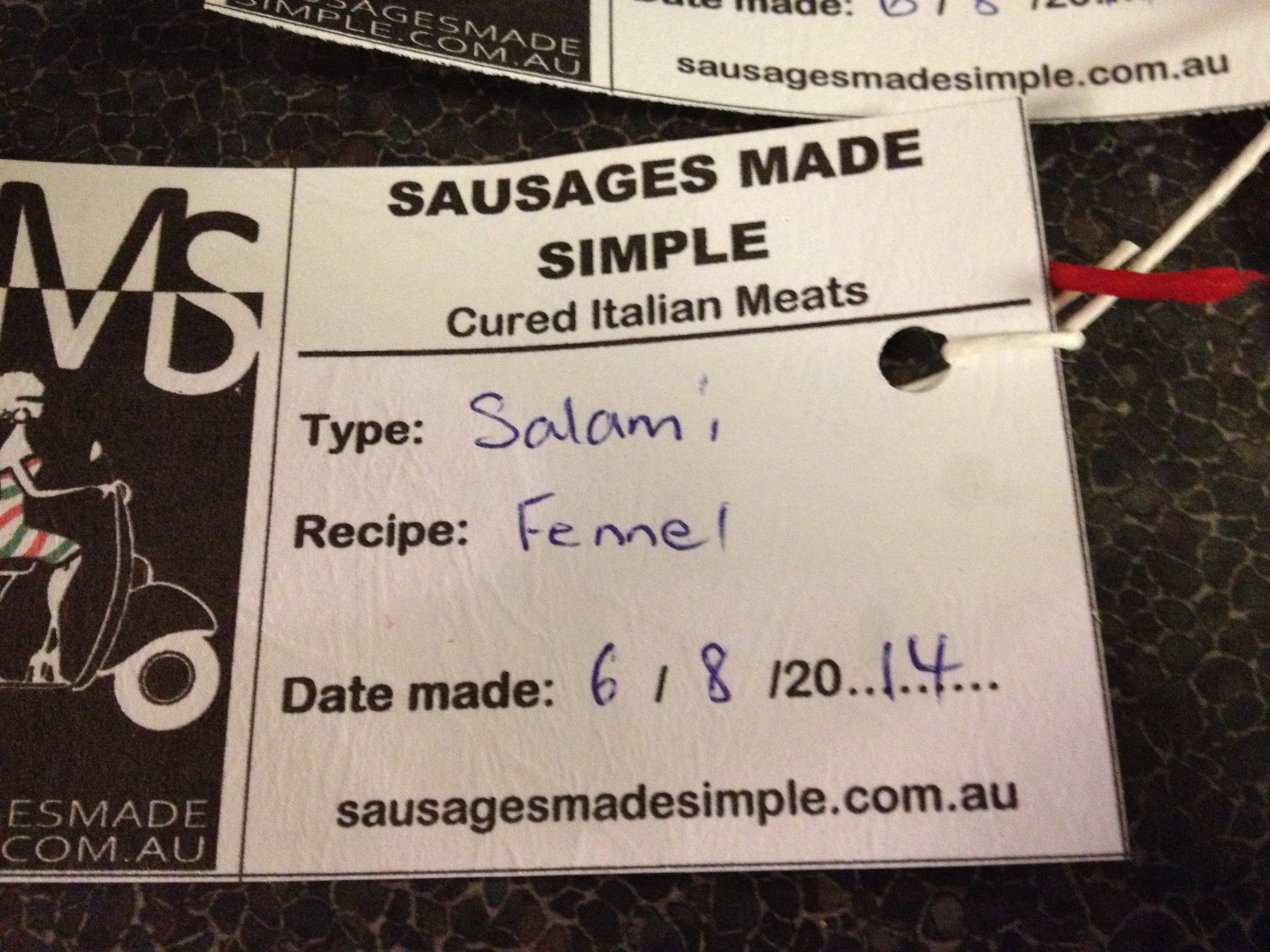
Salami label

Always label your salami so you know when it is ready to eat.

We had to bring a few utensils, like a sharp knife, chopping board, apron, and a notebook and pen.  Also I took a large container in which to transport the salami home in.  I didn’t really think about this too much, and took a small knife, that I sharpened on our knife steel.  More about that later.

Anyway, I won’t be sharing any recipe, but I will tell you what we did.

Firstly we had to cut the pork shoulder, and separate it from the skin.  It had to be in 1cm (½ inch) cubes.  There also needed to be at least 25% of fat mixed in with the meat.  My knife was not up to the job.  Next time I will use my largest and sharpest knife in my knife block.  It took ages to cut through all that pork.

Salami close up

You can see the fat marbling through the casing

Then we ground about 1.1kg (2.4lbs) of pork shoulder meat using an electric grinder.  The mince was quite coarse and I believe that we used a size 12 cutting blade.

Next we had to measure out the salt, ground pepper, fennel seeds, chilli flakes, and spicy pepper paste.  I was surprised to find that this recipe did not have any sodium nitrate added.

After I thoroughly mixed all the dry ingredients into the mince, we then scooped the sausage mixture into the filling machine.  We used manufactured collagen casings, which need to be soaked in water.  These were then tied in a knot at one end, tied off again with red twine, and then pulled the casing over the funnel of the filling machine.  I then pricked the end with the pricking tool, to let a little bit of air out of the casing.

Salami label attached to bottom

Salami label attached to bottom

I then asked a classmate to carefully cranked the handle to fill the casing whilst holding the casing with the other.  A bit tricky, but after the second salami, I was a natural!

The teacher then checked for firmness (minds above the belt please).  My salami was firm enough, so I didn’t need to tie a string around the middle to firm it up.

Then all that was left to do was leave about 7cm (2.7 inches), tie it off with red twine in a double knot, and slide netting over the salami using a salami tube.  All very cool.

Salami ends tied off with loop

Salami ends tied off with loop for hanging.

We then had to check for any air pockets and prick them out with a pricking tool.

After washing our hands, the teacher then let us sample a few types of salami on some french loaf.  There was a fennel style just like we had made, but without chilli flakes.  Also we tried a chilli flavoured salami, which was equally delicious.

All I had to do then was wash up my utensils, pack away my salami, and travel home.

Once home, I showed Kim my two salami (why show her one, when a man has two!).  She was mightily impressed with the size and firmness of my creation.  The salami had to rest horizontally for the evening, so I placed them on a clean chopping board and put a cheese cloth over them.

Ben was also very impressed, and his first thought was of putting them on pizza.  I suppose I could whip up a batch of mozzarella to go with it!

Salami by Gav

Salami with chilli. Big boys aren’t they?

Tonight when I got home, I hung them up in the laundry on the drying rack, where they will stay for about four weeks while they cure.  We were told that the environment needed to be about 70% humidity, 13-15°C (55-59F), and it must have airflow to prevent mould growth.

I was hoping to hang them in my cheese fridge, but the last one condition knocked that on the head.  Besides, they were too long to fix in the fridge anyway!  If it does grow any mould, I have been told to wipe it off using a dry cloth with a little olive oil.

Salami hanging in laundry

Salami hanging in laundry

Once cured, we will vac pack for storage in the normal refrigerator at 4°C.

Looking forward to Wednesday 3rd of September to try this delightful creation.

The great news is that my friend Stacey has offered me her seldom used Sausage machine for a small fee.  I am very excited of making a few more smallgoods like this one.   I will get a kit from Cellar Plus, and try to whip up some more cured meat using my newly learnt skills.  I will also try and source the meat locally, and biodynamic if I can get it.

With all the cheese and the salami around here, the laundry looks like a deli counter at Queen Vic Markets!

Where will I find the time?

Will this article help someone you know? If so help them out by sharing now!

  • Click to share on Facebook (Opens in new window) Facebook
  • Click to share on X (Opens in new window) X
  • Click to share on LinkedIn (Opens in new window) LinkedIn
  • Click to share on Reddit (Opens in new window) Reddit
  • Click to share on Pinterest (Opens in new window) Pinterest
  • Click to share on Tumblr (Opens in new window) Tumblr
  • Click to print (Opens in new window) Print
  • Click to email a link to a friend (Opens in new window) Email
  • More
  • Click to share on Pocket (Opens in new window) Pocket

Filed Under: Preserving, skills Tagged With: Salami

« Previous Page

Search This Blog

Follow my work

About Gavin Webber

About Gavin Webber

An Ordinary Australian Man Who Has A Green Epiphany Whilst Watching A Documentary, Gets a Hybrid Car, Plants A Large Organic Vegetable Garden, Goes Totally Solar, Lowers Consumption, Feeds Composts Bins and Worms, Harvests Rainwater, Raises Chickens, Makes Cheese and Soap, and Eats Locally. All In The Effort To Reduce Our Family's Carbon Footprint So We Can Start Making A Difference For Our Children & Future Generations To Come.

Delve Into the Archives

Visit Our Online Simple Living Shop

Little Green Workshops

Top Posts & Pages

Hot Chilli Chutney
Black Aphids On Garlic
Tips for Growing Citrus in Pots
Strawbridge Family Inspiration
Curing Black Olives
Growing Queensland Blue Pumpkins (Winter Squash)
Broad Bean Rust
The Ant and the Grasshopper
All Good Things Come to an End
Wensleydale Cheese Recipe and Method

Recent Awards

Recent Awards

Local Green Hero

Categories

Favourite Daily Reads

Debt Free, Cashed Up, and Laughing

The Off-Grid Solar House

Greener Me

The Rogue Ginger

Little Eco Footprints

Down To Earth

Surviving the Suburbs

Little Green Cheese

Eight Acres

The Witches Kitchen

TGOG Readers On-line

Carbon Offset website

Copyright - Gavin Webber © 2025