• About
  • Archive
  • Contact
The Greening of Gavin
  • Home
  • Our Green Shop
    • Little Green Workshops
  • Green Workshops
    • Cheese Making
    • Soap Making
    • Soy Candle Making
  • eBooks
    • Clay Oven eBook
    • Keep Calm and Make Cheese eBook
  • Podcast
    • TGOG Podcast
    • TGoG Podcast Archive
    • Little Green Cheese
  • Vlog
  • Cheese
  • Green Living
    • Chickens
    • Gardening
    • Soap Making
    • Recipes
    • Climate Change
    • Peak Oil
    • Solar Power
  • Resources

Less Toxic Living – Book Review and Giveaways

November 19, 2013 @ 21:09 By Gavin Webber 6 Comments

Something that I have been interested in for a while is how to remove toxic chemicals from our home and lifestyle.

We already have an organic suburban food farm, and eat mainly biodynamic meat a few times a week.

But one thing that we haven’t tackled was other products in our home, besides a few basic green cleaning products.

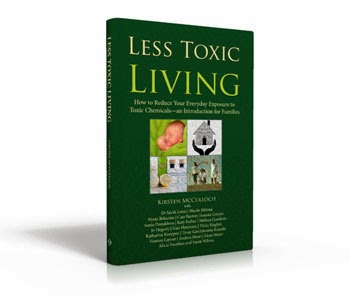
So you can imagine my delight when I was approached by Kirsten McCulloch, who blogs over at Sustainable Suburbia, to review her new book about the subject and be part of the book blog tour.  The book is titled Less Toxic Living – How To Reduce Your Everyday Exposure To Toxic Chemicals: An Introduction for Families.  Just what I needed at the right time in my journey.

The book weighs in at just over 200 pages, and is jam packed with valuable, well researched and referenced material leaving you no doubt about the authenticity of the information.  It is written as a collection of articles from 19 individual contributors, which are grouped into themes such as Your Home, Cleaning, Food & Water, Plastics and, Cosmetics & Skin Care.

You may already know some of the contributors from popular blogs and books;

Dr Sarah Lantz (Chemical Free Kids) | Nicole Bijlsma (Healthy Home, Healthy Family)|Nyree Bekarian | Cate Burton | Joanna Cozens | Sonia Donaldson | Katy Farber |Melissa Goodwin | Jo Hegerty | Kate Hennessy | Tricia Hogbin | Katharine Koeppen |Teray Garchitorena Kunishi | Vanessa Layton | Andrea Muse | Alexx Stuart | Alicia Voorhies and Sarah Wilson.

You would think that with all these writers it would make the book difficult to follow, but this is not the case. Due to the grouping, I found that the themes flowed well and complimented each other.

One of the great features of this book is that you do not have to read it cover to cover to get value.  You can skip to any section, which stand alone, and learn about your chosen toxic topic.

The only fault I found was with formating.  A few chapters only list Metric or US Imperial measurements and not both, however it does not detract from the overall book.  Also, I hope the eBook version has hyperlinks when released, as there are a lot of websites within the references that would be easier to visit if linked.

I particularly enjoyed the chapters about Food & Water and Plastics, learning quite a bit in the process.

Did you know that food additives can cause behavioural issues and learning difficulties in children?  I had often joked about red cordial, but it is much more serious than that.  It left me thinking about my own diet, albeit quite good in that regard.

The other chapter that made me really think was Five Foods That Have Sneaky Additives.  I really wanted to research this further as I found it didn’t go deep enough, but remember that this book is only an introduction.

Although only a handful of chapters long, the Plastics section really hit it home for me.  I will be actively weeding out harmful plastics around our home over the next few weeks.

I highly recommend this book for all who want to learn how to lower the toxic chemicals around your home and are looking for an all-round introduction to the subject.  I will give it 5 stars, as I really needed an introduction to this area of sustainable living.

Now I have even better news.  For a limited time, Kirsten is giving away the eBook version for FREE, with a lot of free bonus material.

You can pick up the free copy from now until 3rd December 2013 at the book website lesstoxicliving.net.  However, you will need my special access code GREENGAV to download it and the free bonuses.

Less Toxic Living is also available as a paperback at Amazon, but it will be available in this format in Australia at this link; lesstoxicliving.net/buy-it-in-print/

Let me know what you think of it in the comments if you download and read it.  I would be interested in your opinion.

Will this article help someone you know? If so help them out by sharing now!

  • Click to share on Facebook (Opens in new window) Facebook
  • Click to share on X (Opens in new window) X
  • Click to share on LinkedIn (Opens in new window) LinkedIn
  • Click to share on Reddit (Opens in new window) Reddit
  • Click to share on Pinterest (Opens in new window) Pinterest
  • Click to share on Tumblr (Opens in new window) Tumblr
  • Click to print (Opens in new window) Print
  • Click to email a link to a friend (Opens in new window) Email
  • More
  • Click to share on Pocket (Opens in new window) Pocket

Filed Under: Books, Cleaning, food, GreenHome, Sustainable Living

Clean Again, Naturally

December 11, 2012 @ 21:54 By Gavin Webber 13 Comments

What would you say if I said I could save you at least $20-30 off your fortnightly shopping bill by following some simple cleaning tips?

Just by using natural cleaners that you can make yourself, you will save money, and keep nasty chemicals out of your waste stream that would otherwise make its way into our waterways.  Easy peasy, lemon squeezy!

Eco Cleaning

Since our family started the journey towards a more sustainable lifestyle, our cleaning methods have changed towards non-toxic products with obvious benefits.

Laundry

We started using grey water at the very beginning of the journey to water the garden, so we needed to change our laundry powder to one that had no Phosphorous and no Sodium so that we could use the water neat in the garden.

The phosphorous would have damaged the native Australian plants, and the sodium tends to make the soil repel water, and increases the salinity.

Also, any run-off that the plants don’t use, does not contaminate the ground water. We found, after trying a couple of NP brands, that the Planet Ark Aware laundry powder worked the best for us.  Earth Choice came in at second when we can’t source Aware.

After reading an article in Choice Magazine, we found that it was not made from any petrochemicals, but there are probably similar brands now around the world. Kim raves about it to anyone who will listen, because a 1 Kg box lasts her approximately 8 weeks for 4 peoples clothes as you only use 3 tablespoons per wash. We also use a NP fabric softener, but don’t use it very much, and have been substituting with white vinegar in the last two months with great results. When washing towels, Kim pops in a few drops of eucalyptus oil to kill of any bacteria. It makes them smell nice too.

I believe that Seventh Generation also have a good product rain in the US and Canada.

Kitchen

With the laundry sorted, we looked to the kitchen. We buy an earth friendly washing up liquid for the kitchen dishes that is also low in phosphates and sodium. We still use the dishwasher occasionally when we have a mountain of dirty dishes. We use bi-carbonate soda (baking soda) instead of dishwashing powder, and vinegar for the rinse aide.

We have found this to be very effective, even on some of the tougher dirt. To get rid of a smelly dishwasher we give it a thorough clean with vinegar and bi-carb soda, then put it through a cycle. So we are not only saving a fair bit of water, and about 8 kWh of electricity a week, and caustic dish washing tablets, but we have also realised something profound.

When you wash dishes by hand, and you have someone drying them with you, you actually talk to each other and everything is cleaned far better than it would have in a dishwasher. Not only do you have quality control via an instant feedback loop, you can have a laugh and a joke around at the same time. There is only one rule that we stick to, and that is that the cook does not wash up. You can shotgun for the rest of the washing, drying or putting away!

Lemons and bi-carb soda are also great for getting rid of stubborn burnt on food at the bottom of pots and pans.  When life gives you lemons, scrub a pot with them!

Glass

Cleaning windows and mirrors is a cinch with white vinegar in a spray bottle and the free local newspaper. Not only is it cheap, but it keeps mould away, and prevents mirrors from fogging up. It gives a nice clear finish without any smell. You can throw that Windex away now!

Surfaces

We also use white vinegar as an anti-bacterial to wipe the kitchen surfaces when dirty. Stubborn stains are dealt with by a paste of water and bi-carb soda. I would rather have a small child accidentally swallow vinegar than some of the other nastier cleaning products kept under the average kitchen sink!  If I have an abundance of lemons, I use one cut in half to clean chopping boards before giving them a coat of olive oil.

Drains

About a month ago we had a bad smell coming out of the kitchen sink, so it was out with the bi-carb soda, and down the drain with about 4 tablespoons of the white powder. After about a minute I followed it up with a quarter of a cup of white vinegar and let it all fizzle. Let it go for about 3 minutes and then flush with some very hot water. Our drain have never have smelled so nice, and I may have gotten rid of a lot of built up grease as well.

Bathroom

The last cleaning thing I can think of is that my daughter Megan gives the shower a weekly once over with some paste made up of bi-carb and water, with an micro-fibre glove and old rags, which gets rid of the soap scum that collects there. A little bit hot water afterwards washes it all away. Oh, I forgot the toilet. We use bi-carb soda to clean it as well, with a little white vinegar in the final flush.

Personal Hygiene

As for washing ourselves, we all use pure, home-made soap.  I even wash my very short hair with it.   Kim uses an organic shampoo, but I have heard that bi-carb works just as well in very small doses.

I shave with a pigs bristle brush, having given away shaving cream in a can (just use our home made soap to lather), but am having trouble finding an alternative to disposable razors or blades. I don’t shave very much, as I have a goatee, so I would not use as many blades as the average guy. I might investigate a cut throat razor in the near future, as they last for a very long time, and you sharpen (or is it blunt-en) it yourself.  Sweeney Todd eat your heart out!

Summary

Well that is about all I can think that we use. We simply asked the question to see if the answer was that if things were safe for us, they would be safe for the planet. We made the changes slowly over the course of about a year. If you have a couple of bottles of white vinegar and a big box of bi-carb soda, you have almost all you need to clean the house up.

I did get most of the tips originally from reading Greeniology: How to Live Well, be Green and Make a Difference. Tanya Ha wrote a whole chapter on green cleaning. It helped finding all the good tips in the one place, and the tips were simple to implement (I even met her once (more like stalked), and got my copy of this book autographed).

We save so much money on cleaning products (vinegar and bi-carb are cheap as chips), we feel safe when we clean, and know that it is better for the planet.

Simply the simplest and greenest products we could find make a hell of a difference!

Do you use a natural green cleaner?  Do you have any tips that you can share?  I am sure readers would love to know.

Will this article help someone you know? If so help them out by sharing now!

  • Click to share on Facebook (Opens in new window) Facebook
  • Click to share on X (Opens in new window) X
  • Click to share on LinkedIn (Opens in new window) LinkedIn
  • Click to share on Reddit (Opens in new window) Reddit
  • Click to share on Pinterest (Opens in new window) Pinterest
  • Click to share on Tumblr (Opens in new window) Tumblr
  • Click to print (Opens in new window) Print
  • Click to email a link to a friend (Opens in new window) Email
  • More
  • Click to share on Pocket (Opens in new window) Pocket

Filed Under: Cleaning

Ditching the Clothes Dryer

October 5, 2011 @ 12:00 By Gavin Webber 26 Comments

I have a confession to make.  We had an electric clothes dryer!  The shame.  It used to use to be rated at 1800 watts on the warm setting and 2200 watts on the hot setting.  Such a guzzler of electricity, and it was the cause of some very high winter electricity bills.

The good news is that it broke over a year ago when the element burnt out, and I only took it off the wall a few weeks ago and took it to the metal recyclers.

The even better news is that we did not replace it with another electric clothes dryer, even though our clothes drying needs have not changed.  We still need to dry clothes when it is raining, or cold in winter, or humid in summer.

The best news of all is that we have learnt a few tricks and tips that we can now share with you, now that we have managed to go dryer free for over a year.  Here they are.

  1. Don’t replace the broken dryer.  Billions of people on the planet survive without this energy wasting device.  You will save a stack of money by avoiding the purchase, have lower electricity bills, and a much lower carbon footprint.  Even if you use GreenPower, you are still saving loads of money.
  2. Look for a good airer/clothes rack/horse that holds at least one load of washing.  We bought two for those big washing days.
  3. Use solar passive in winter to dry your clothes indoors.  We put the airers into the front room which we close off and it gets nice and toasty in there.  It drys the clothes in a day or so and you don’t have to brave the elements to hang them out. 
  4. If you use a heater of some sort in the winter evenings, then place the clothes airer a safe distance away from the heat source.  Your clothes will be dry by morning.
  5. Plan ahead.  If you know the kids need their school uniforms for Monday, then do a quick load on eco-mode (don’t forget the soap nuts) and load up the airer on Friday night.  They will be dry by Sunday.
  6. String up some cord beneath an under cover outdoors area, preferably one that gets a good breeze.  Your laundry will be dry in a day, even when it is wet outside.   If it is sunny, then use the hills hoist if you have one.
  7. Install a retractable clothes line in your laundry using the space that used to be taken up by the dryer!
  8. Celebrate your successful transition from clothes dryer addict to green, clean, laundry machine.

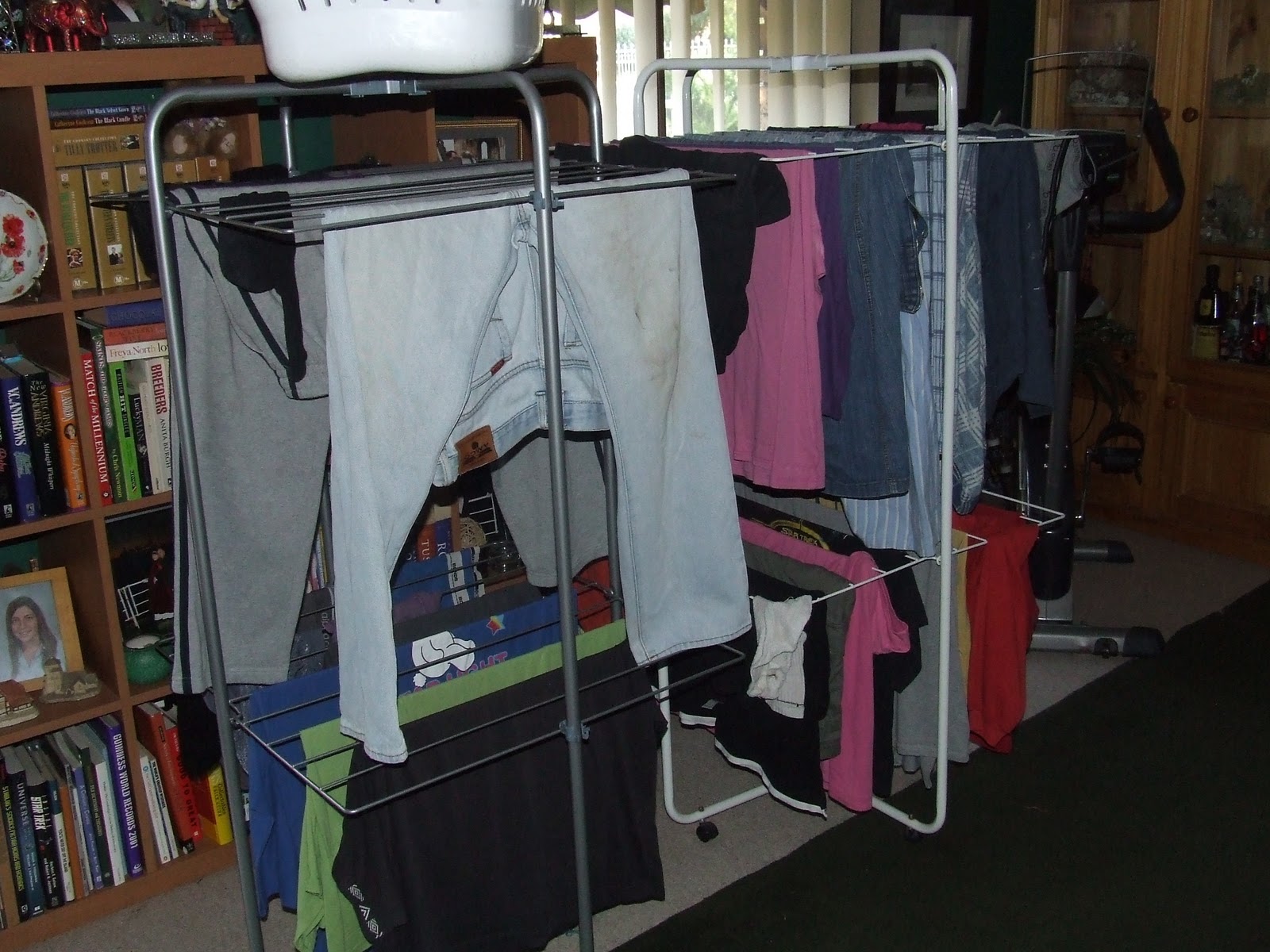
Here are some pictures of our laundry drying techniques.  Simple yet effective.

    Clothes Airer
    Undercover clothes line

    Retractable indoor clothes line (in)

    Retractable indoor clothes line (out)

    I give most of the credit to Kim, who could have just told me to go and buy a new one when our old dryer broke, but it was her idea to try life without the electric dryer, so I did not suggest otherwise.  Well done to her for going against the grain of the normal societal trend.

    Dry clothes the natural way.  It is the only way to go.  Our electricity bill has never been so low in winter, and our clothes last longer and don’t have that static cling you get from using a dryer. 

    Nice one Kim!  Have any of you ditched the dryer?

    Will this article help someone you know? If so help them out by sharing now!

    • Click to share on Facebook (Opens in new window) Facebook
    • Click to share on X (Opens in new window) X
    • Click to share on LinkedIn (Opens in new window) LinkedIn
    • Click to share on Reddit (Opens in new window) Reddit
    • Click to share on Pinterest (Opens in new window) Pinterest
    • Click to share on Tumblr (Opens in new window) Tumblr
    • Click to print (Opens in new window) Print
    • Click to email a link to a friend (Opens in new window) Email
    • More
    • Click to share on Pocket (Opens in new window) Pocket

    Filed Under: Cleaning, energy efficency

    « Previous Page
    Next Page »

    Search This Blog

    Follow my work

    About Gavin Webber

    About Gavin Webber

    An Ordinary Australian Man Who Has A Green Epiphany Whilst Watching A Documentary, Gets a Hybrid Car, Plants A Large Organic Vegetable Garden, Goes Totally Solar, Lowers Consumption, Feeds Composts Bins and Worms, Harvests Rainwater, Raises Chickens, Makes Cheese and Soap, and Eats Locally. All In The Effort To Reduce Our Family's Carbon Footprint So We Can Start Making A Difference For Our Children & Future Generations To Come.

    Delve Into the Archives

    Visit Our Online Simple Living Shop

    Little Green Workshops

    Top Posts & Pages

    Hot Chilli Chutney
    Curing Black Olives
    Strawbridge Family Inspiration
    Homemade Pickled Onions
    Black Aphids On Garlic
    The Ant and the Grasshopper
    How To Remove Scaly Leg Mites
    Tips for Growing Citrus in Pots
    Selling Your Own Soap in Australia
    Fancy Soap Bars

    Recent Awards

    Recent Awards

    Local Green Hero

    Categories

    Favourite Daily Reads

    Debt Free, Cashed Up, and Laughing

    The Off-Grid Solar House

    Greener Me

    The Rogue Ginger

    Little Eco Footprints

    Down To Earth

    Surviving the Suburbs

    Little Green Cheese

    Eight Acres

    The Witches Kitchen

    TGOG Readers On-line

    Carbon Offset website

    Copyright - Gavin Webber © 2025